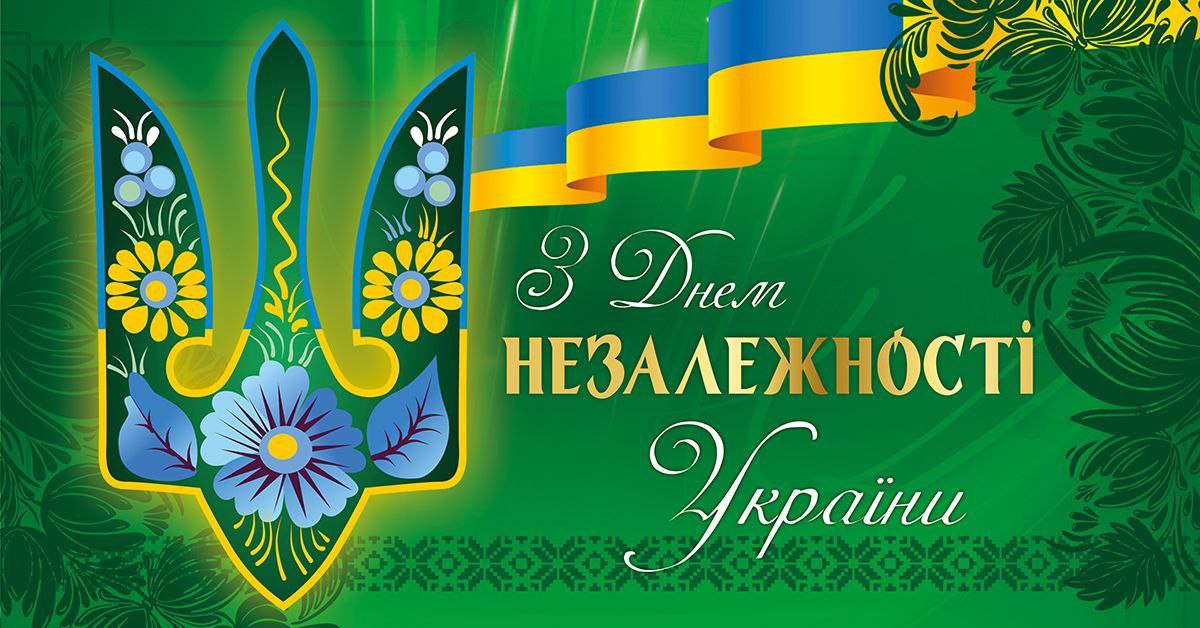
Our own independent state is a conscious choice and the most valuable asset of Ukrainians. The modern independence of Ukraine – 34 years since the adoption of the Act of Proclamation of Independence of Ukraine – is based on the thousand-year legacy of statehood from the formation of the Ancient Russian state in the 9th century, and we are the full heirs of the state and cultural tradition of Rus. An important step towards the restoration of historical justice was the adoption of the Declaration on the State Sovereignty of Ukraine on July 16, 1990. The fateful events of 1991 should be viewed as the restoration of Ukraine's statehood, primarily the Ukrainian People's Republic.
In the 20th century, the Ukrainian state could have become independent several times. Sometimes, separate parts of the country declared independence. Perhaps, if at least one of these attempts had been successful, there would be a different Ukraine on the modern political map of the world, with different borders and a different history. Let's dwell on the most significant events.
Proclamation of Independence of the Ukrainian People's Republic
Date: January 22, 1918
The Central Council of the UNR, headed by Mykhailo Hrushevsky IV Universal, proclaimed the independence of the Ukrainian People's Republic. This was the first decision in the history of modern Ukraine when the Ukrainian people proclaimed an independent sovereign Ukrainian state and finally severed relations with the imperial center: "Today, the Ukrainian People's Republic becomes an independent, independent, free, sovereign state of the Ukrainian people. We want to live in harmony and friendship with all neighboring states, such as: Russia, Poland, Austria, Romania, Turkey and others, but none of them can interfere in the life of the independent Ukrainian Republic."
However, the Fourth Universal was proclaimed too late, when the culmination of the Ukrainian national movement had already passed, and the country was engulfed in a deep economic and political crisis. In early 1918, the Ukrainian Central Rada was losing position after position, and by mid-January, Soviet power had been established in many cities of Ukraine.
Declaration of Independence of the Western Ukrainian People's Republic
Date: October 19, 1918
After the collapse of the Austro-Hungarian Empire, numerous peoples were given the chance to gain independence and create their own state. Ukrainians Galicia decided to take advantage of this unique chance and declare their independent state. The capital of the new state was Lviv, with Yevhen Petrushevych as president. The new republic covered the territory inhabited by Ukrainians – Galicia, Bukovina and Transcarpathia.
January 22, 1919 The ZUNR united with the Ukrainian People's Republic. The ZUNR was occupied On July 18, 1919, during the Ukrainian-Polish War, and the decision of the Council of Ambassadors of the Entente Powers regarding Poland's eastern borders of March 15, 1923 officially consolidated Poland's sovereignty over the entire territory it actually possessed, including Eastern Galicia.
In 1917 Kuban People's Republic became one of the state formations that emerged after the collapse of the Russian Empire. And February 16, 1918 In 1920, it declared independence, following the example of the Ukrainian People's Republic. Its leadership included many descendants of the Zaporizhian Cossacks who had been resettled here at the end of the 18th century. The republic existed until the spring of 1920, during which time it tried several times to unite with Ukraine. The Kuban Cossacks negotiated with three Ukrainian authorities - the Central Rada, the government of Hetman Pavlo Skoropadsky, and the Directory of the UNR. But it never worked out, and both republics, the Ukrainian and the Kuban, eventually collapsed under Bolshevik pressure.
In December 2018, the official publication of the Kyiv City Council, the newspaper "Khreshchatyk", published the adopted decision of the Kyiv City Council to rename one of the streets in the Desnyanskyi district of the city to Kubanska Ukraina Street.
It is important to remember that despite all the doubts about the renaming, honoring the memory of Kuban Ukraine in the toponymy of Kyiv is fully consistent with modern European approaches to the policy of national memory.
Proclamation of independence of Carpathian Ukraine
Date: March 15, 1939
After the Munich Agreement in September 1938, the difficult international situation forced Czechoslovakia to agree to provide Carpathian Ukraine the status of an autonomous republic. On November 22, 1938, the Prague Parliament adopted a constitutional law on the autonomy of Carpathian Ukraine, after which Czechoslovakia became a federal state of Czechs, Slovaks, and Carpathian Ukrainians. The autonomy of Carpathian Ukraine irritated Hungary.
In these difficult days, March 15, 1939, The Sejm proclaimed the full state independence of Carpathian Ukraine. According to the constitution adopted by the parliament, the newly created state was called Carpathian Ukraine with a state system - a presidential republic. Ukrainian was declared the official state language, the blue-yellow banner and the Ukrainian national anthem "Ukraine is not dead yet" were recognized as the state flag and anthem of the republic.
Augustyn Voloshyn was elected President of Carpatho-Ukraine. However, on March 18, Hungarian troops managed to completely occupy the territory of Carpatho-Ukraine.
Proclamation of the restoration of the independence of the Ukrainian state
Date: June 30, 1941
The Act of Restoration of the Ukrainian State was proclaimed June 30, 1941 in Lviv occupied by German troops. This event became one of the most important in the history of the OUN-UPA, as it marked a clear decision to build its own state outside the autonomies within any other state. The declaration of independence came as a complete surprise to the German command, whose plans did not include an independent Ukraine. Within a week, they were arrested Stepan Bandera and Yaroslav Stetsk, as well as other OUN leaders. September 1941 was remembered in Lviv for the total arrests and executions of OUN members.
The next opportunity for Ukraine to gain independence came 50 years later, and despite repeated experiences of setbacks and defeats, it ended in success. August 24, 1991 Ukraine became independentAnd it was no longer a phantom state, gripped by the grip of war, conflict, and history, destined to exist for either one night or two years.
December 1, 1991 In the All-Ukrainian referendum, Ukrainians confirmed their desire to live in an independent state., making it an irreversible fact of history. 90.32% of voters answered affirmatively to the question in the ballot “Do you confirm the Act of Proclamation of Independence of Ukraine?”.
Our independence has come at a high price. – the large number of lives of those who fought and are fighting today for the idea of a free Ukraine with and without weapons, the countless years of lost freedom of those who sat in camps and prisons for it.
Today, in the conditions of a large-scale war between the Russian Federation and Ukraine, we are fighting back with dignity and once again defending our own freedom and independence, as well as peace in Europe. Ukraine's independence is a beacon of freedom in Europe.
(Arranged based on materials:
