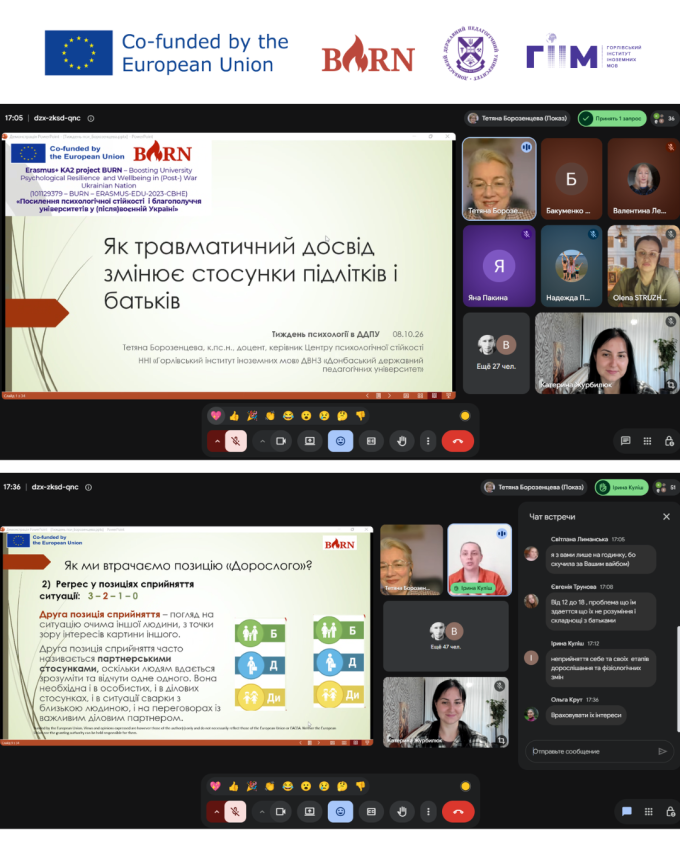
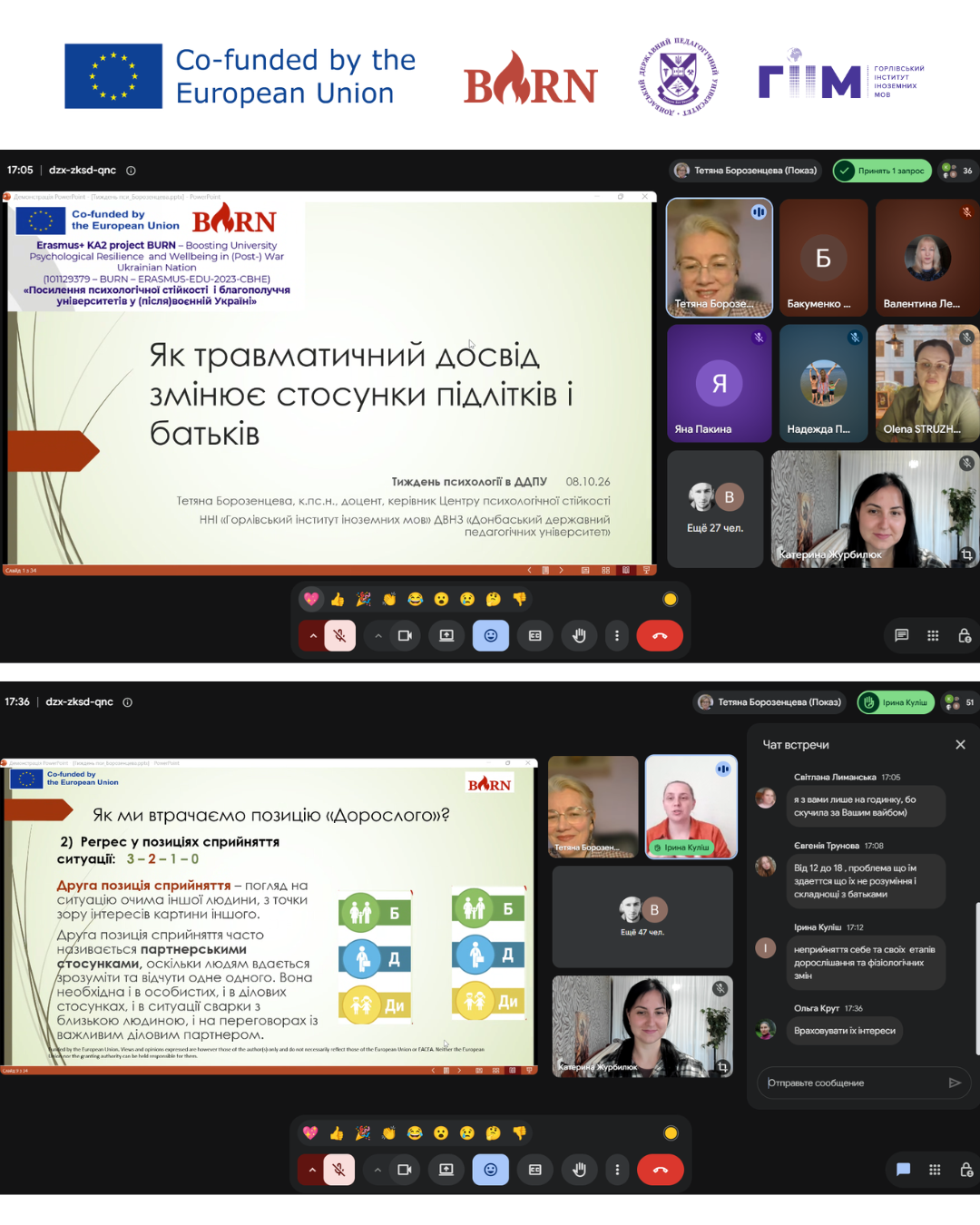
On October 8, 2026, as part of Psychology Week, a webinar “How Traumatic Experience Changes Relationships between Adolescents and Parents” was held at the DSPU, which was conducted by Tetyana Borozentseva, Candidate of Psychological Sciences, Associate Professor, Head of the Center for Psychological Resilience of the National Research Institute of the Institute of Psychological Resilience. 53 people participated in the event.
During the meeting, the peculiarities of adolescence, its emotional and behavioral manifestations, as well as the impact of traumatic experiences on the interaction of children with parents were discussed. Particular attention was paid to how traumatic events can affect emotional regulation, perception of oneself and others, the ability to constructively communicate and build trusting relationships.
Participants were introduced to approaches to understanding adolescent behavior, including Rudolf Dreikurs' concept of unconscious priorities and Eric Berne's theory of transactional analysis. They examined how stress and traumatic experiences can make it difficult to recognize one's own emotions, reduce the ability to make informed decisions, and provoke automatic reactions in communication.
The practical part was devoted to the development of effective communication and reflective listening skills. Using real-life situations and case studies, participants analyzed different ways of responding to the emotional experiences of adolescents, learned to distinguish between support, evaluation, interpretation, and excessive questioning. Particular attention was paid to the ability to hear not only the words of the interlocutor, but also the feelings and needs behind them.
The meeting contributed to a deeper understanding of the psychological mechanisms of interaction between parents and adolescents and emphasized the importance of empathy, safe dialogue, and support in the process of overcoming the consequences of traumatic experiences. Participants received practical guidelines for building more trusting relationships and constructive communication within the family.